
Travel Guide
Cat Cat Village Sapa Vietnam: Entrance Fee, Things to Do & Tips

Jul
What is Cat Cat Village?
If you are planning your first trip to northern Vietnam, Cat Cat Village Sapa Vietnam is likely right at the top of your itinerary. Nestled at the foot of the Hoang Lien Son mountain range, this historic community offers an incredibly accessible look into local culture.
Visiting Cat Cat Village in Sapa allows you to experience traditional Black Hmong heritage, dramatic terraced landscapes, and rushing waterfalls all within a single morning.
While the village has evolved into a highly curated cultural attraction rather than an untouched, isolated settlement, it remains a fantastic introduction to the region. To maximize your time in Lao Cai Province, you can easily pair a morning walk here with a comprehensive Sapa 2-day itinerary to keep your schedule running efficiently.

Where is Cat Cat Village in Sapa?
Perched on the steep hillsides of the iconic Muong Hoa Valley, this scenic settlement sits roughly 2.5 kilometers southwest of Sapa Town center. Because of this proximity, Sapa Vietnam Cat Cat Village serves as the most immediate cultural escape from the urban hustle of the town’s main square.
The area was established in the mid-19th century by the Black Hmong people. They carefully carved out a life based on corn cultivation, rice terracing, and expert craftsmanship. As you explore the stone-paved loop, you will notice that this isn’t just an outdoor museum. It is a living neighborhood where local families still dye textiles and maintain century-old customs.
The surrounding landscape is dominated by the towering peak of Fansipan in the distance. If you want to expand your geographic perspective of the valley, spend an afternoon climbing Ham Rong Mountain. It will reward you with an unmatched bird’s-eye view over the entire township and the descending valley trail.
How to Get to Cat Cat Village from Sapa
Figuring out how to get to Cat Cat Village from Sapa is straightforward. But the topography catches many off guard. The route from town is entirely downhill. That means the return journey is a punishing, steep climb. Depending on your budget and energy levels, you have three distinct ways to navigate the journey from Sapa to Cat Cat Village.

Walking to Cat Cat Village
If you choose to walk to Cat Cat Village Sapa, head down Fansipan Road directly out of town. The 40-minute trek offers beautiful sweeping views of the valley. While the Sapa Cat Cat Village walk is highly scenic on the way down, the steep incline on the way back leaves most travelers breathless.
Taxi to Cat Cat Village
Taking a taxi from Sapa to Cat Cat Village is the most seamless option for families. A standard one-way car ride costs around 100,000 VND ($4 USD). However, be aware that cars must stop at the upper main checkpoint. They cannot drive onto the narrow, stone-stepped paths inside the Cat Cat Village Sapa loop.
Motorbike Options
Renting a scooter in town for 100,000 to 150,000 VND per day gives you total flexibility to explore the wider Sapa town to Cat Cat Village route. Alternatively, you can hire a local motorbike taxi (xe ôm) at the lower exit gate for roughly 50,000 VND to whisk you back up to Sapa Town when you are finished walking.
Entrance Fee and Opening Hours
Because the site operates as a managed cultural park, visitors are required to purchase a physical ticket at the main gate checkpoint before entering.
| Visitor Metric | Current 2026 Policy Details |
| Cat Cat Village Sapa Entrance Fee | 150,000 VND (~$6 USD) per adult
70,000 VND per child (1m–1.3m) |
| Cat Cat Village Sapa Opening Hours | 6:00 AM to 6:00 PM daily |
| Optimal Visit Window | 7:00 AM – 9:00 AM (beats the tour buses) |
| Payment Method | Cash only at the main ticket counter |
Local Expert Tip: Many older travel blogs still list the entry cost as 70,000 or 100,000 VND. Ensure your budget reflects the updated tariff of 150,000 VND. That sum directly funds the maintenance of the stone pathways, security, and the daily live cultural shows.
For a broader financial overview of your trip, check our comprehensive guide to the master Sapa entrance fee schedule.

Best Things to Do in Cat Cat Village
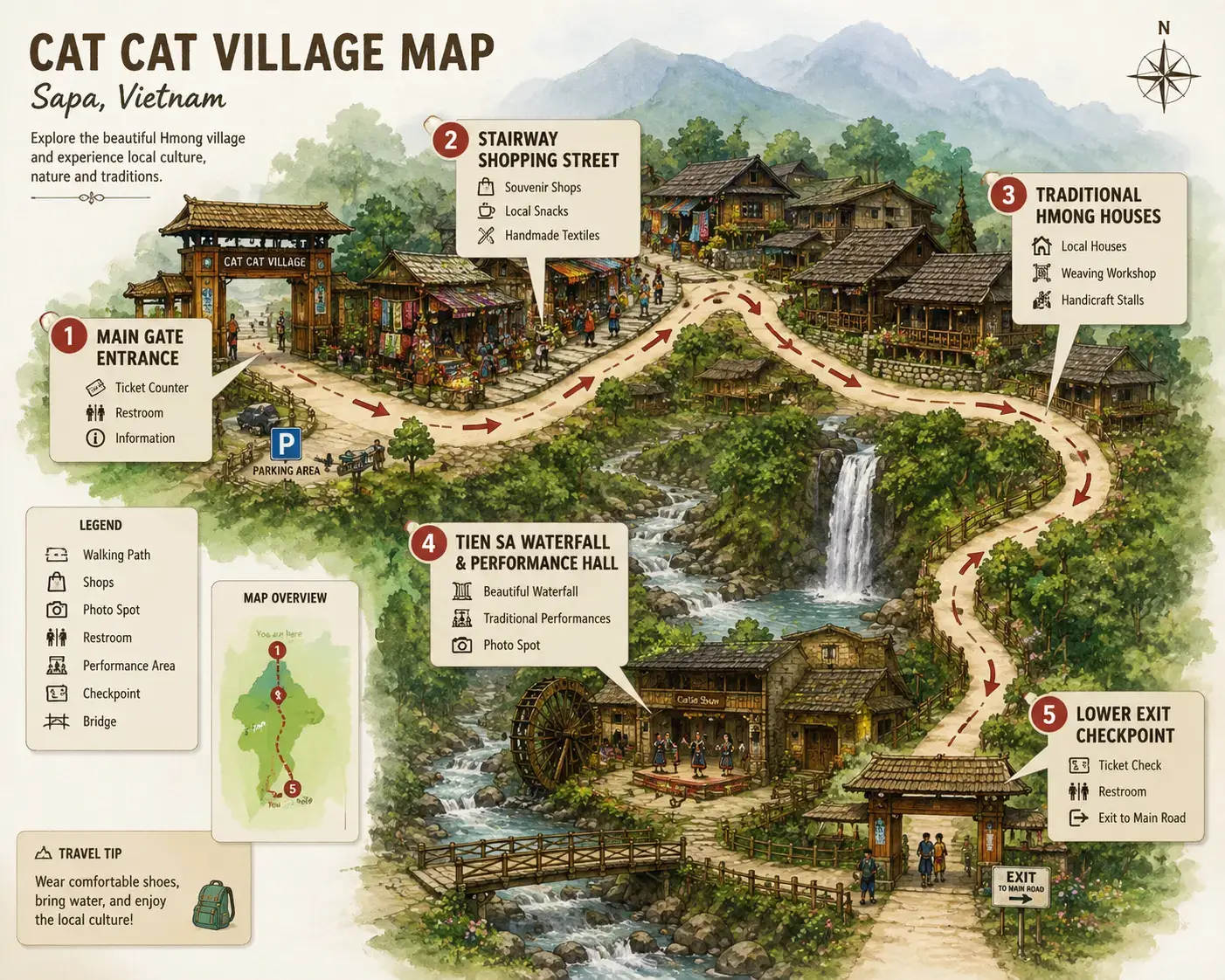
The village layout forms a natural, one-way descending loop. Rather than rushing through, look out for these specific cultural anchors along the trail.
Visit Traditional Houses & Craft Workshops
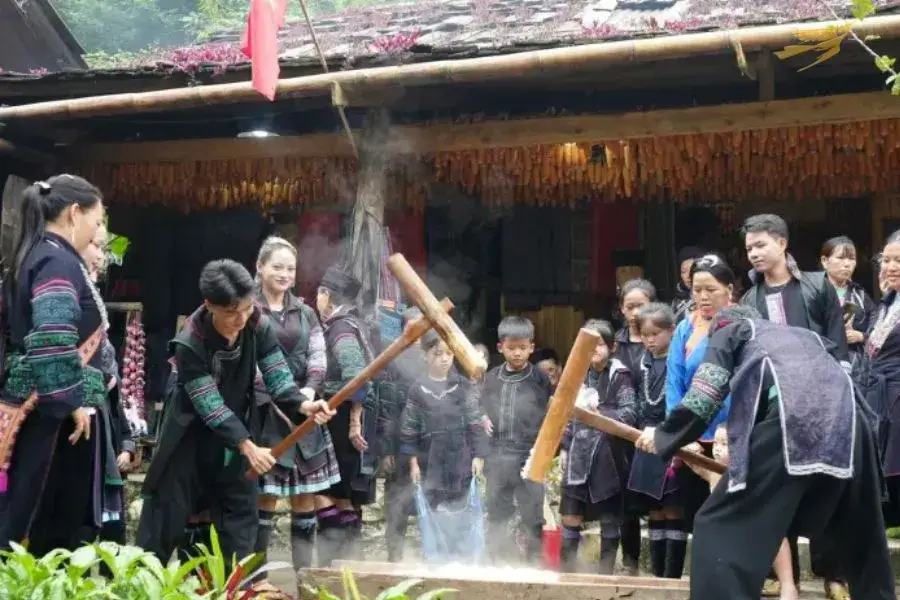
As you move past the initial souvenir stalls, step inside the preserved Pomu wood stilt houses. Here, you can witness genuine indigo dyeing and hemp weaving. Look for the massive wooden rollers used by artisans to buff and give a characteristic sheen to the deep blue fabric.

Admire Waterfall Area & Giant Water Wheels
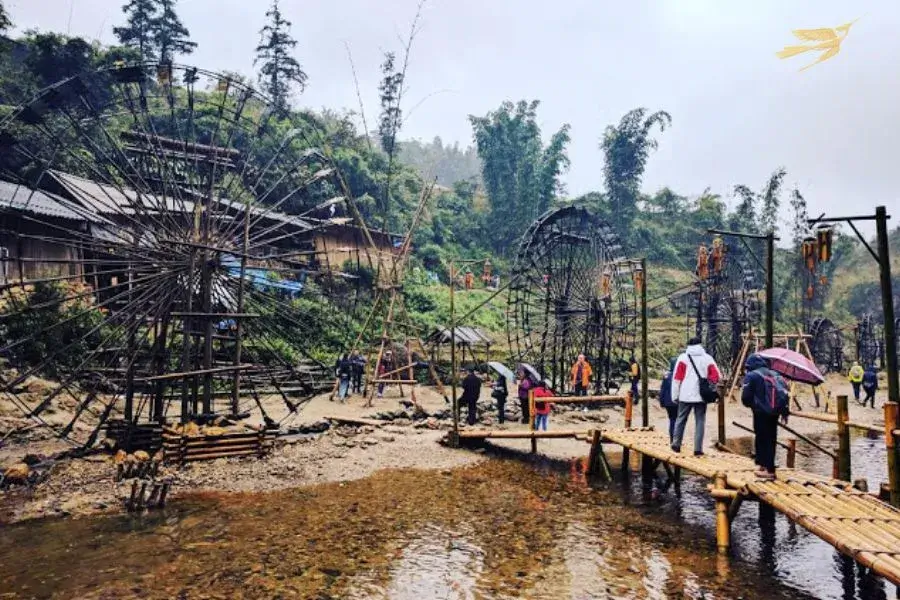
The true heart of the trail is the Cat Cat (Tien Sa) Waterfall. Surrounding the roaring cascade are iconic, giant bamboo water wheels. These ingenious wooden mechanisms use hydraulic energy to pound rice automatically, showcasing traditional Hmong engineering.

Enjoy Cultural Performances
Right next to the riverbeds sits the covered performance pavilion. Included in your ticket price are the live cultural showcases. They run at regular intervals throughout the day. Typically, a show starts at:
- 9:30 AM
- 11:00 AM
- 2:00 PM
- 3:30 PM
However, it is always wise to double-check the seasonal schedule boards posted directly outside the pavilion entrance.
These short, 15-minute performances feature vibrant bamboo dancing (múa sạp) and traditional Hmong flute music. Many consider it a perfect mid-hike rest stop.

Experience Photography Spots & The Rainbow Slide
The village features numerous dedicated photo platforms, swing sets, and floral gardens overlooking the valley. If you want a bit of modern recreation, the Rainbow Slide Cat Cat Village Sapa experience offers a colorful, multi-lane slide down a hillside path for a small additional fee.
This modern development is located along the upper tiers of the hillside trail before you reach the main waterfall. If you prefer an authentic cultural experience, you can easily bypass this area completely by sticking to the main stone-stepped descending spine of the village trail.
While the rainbow slide Cat Cat Village Sapa attraction leans heavily into modern social media trends, it provides a playful detour for families while leaving the lower historic village sections untouched.

Go Trekking
For those seeking an active morning, the independent paths extending past the central waterfall offer excellent light trekking Cat Cat Village Sapa opportunities. These paths loop cleanly through the lower agricultural fields. They offer a quieter look at the landscape away from the primary commercial photo zones.
How Much Time to Spend in Cat Cat Village Sapa
To fully appreciate the craft exhibitions, catch a live dance performance, and navigate the steep stairs at a comfortable pace, you should budget your time carefully. Knowing exactly how much time to spend in Cat Cat Village Sapa prevents you from over-scheduling your afternoon.
- Quick Photo Run (1.5 to 2 Hours): Ideal if you take a vehicle straight to the gate, walk directly to the waterfall center, and take a motorbike taxi out.
- Standard Cultural Exploration (2.5 to 4 Hours): The recommended window. This gives you ample time to tour the historic homes, sit down for a performance, and enjoy a local coffee over the river.
Cat Cat Village Sapa Map and Nearby Attractions
Navigating the Cat Cat Village Sapa map is incredibly straightforward because the main path consists of a single, stone-paved staircase slicing downward through the valley.

If you are trying to decide how to structure your broader itinerary, it helps to look at alternative valley routes. Reading an analysis of Cat Cat Village vs Lao Chai vs Ta Van will show you that while Cat Cat focuses on concentrated cultural exhibits and easy access, Lao Chai and Ta Van offer much longer, raw treks through open agricultural lands.
Where to Eat and Shop Near Cat Cat Village
As you hike along the river, skip the generic packaged snacks and seek out authentic northern mountain cuisine. Stop at a streamside tavern to sample local specialties, such as:
- Com Lam: sticky rice roasted inside bamboo tubes, typically costing around 10,000 to 20,000 VND per tube
- Black chicken soup cooked with wild medicinal herbs
- Thang Co: a deeply traditional, aromatic Hmong cardamon-spiced stew made natively with horse meat and offal. This dish gives a rich, distinct flavor profile unique to the northern highlands.

For shopping, pass by the mass-produced trinkets and look for authentic textile pieces. True Hmong batik fabric features intricate, hand-drawn beeswax geometric patterns that require weeks of meticulous labor.
If you want a wider selection of authentic regional goods, wait until evening to visit a dedicated Market in Sapa town center, where artisans from various communities gather to trade directly.
Local Advice For Visitors
#1 Choose the Right Season
The valley completely transforms throughout the year. Consulting a guide on the absolute best time to visit Sapa is vital. If you want to see the vibrant, emerald-green Sapa rice field vistas, aim for June through August. If you prefer to gaze across golden, terrace harvest fields, plan your trek for late September.
#2 Dress for the Terrain
Weather conditions change rapidly at this altitude. Knowing exactly what to wear in Sapa will save your day.
- Footwear: Leave the sandals behind. The stone steps near the waterfall are perpetually damp, slick, and require sturdy shoes with reliable rubber grips.
- Layers: Bring a compact rain jacket or windbreaker, as thick mountain mist can roll into the canyon within minutes.
#3 Practice Responsible Tourism
Always ask for explicit permission before photographing local weavers or children inside their residential properties. Additionally, avoid handing out small cash or candy to children along the paths. Supporting local craft shops or purchasing from adult vendors is a far more sustainable way to positively impact the community economy.

FAQs
Is the Cat Cat Village walk suitable for strollers or wheelchairs?
No, the loop is entirely inaccessible for wheels. The path relies on steep, narrow, and often uneven stone steps mimicking natural mountain topography. If you are traveling with toddlers, a sturdy backpack carrier is absolutely essential. For travelers with limited mobility, we recommend hiring a private car to take you to the scenic view cafes situated at the very top of the Fansipan Road entrance ridge. This allows you to enjoy the panoramic valley views without entering the steps.
Where exactly should I arrange to meet my driver or vehicle after the walk?
This is a critical logistical detail most maps miss: Cat Cat Village uses a strict one-way walking loop. You will enter through the Upper Gate checkpoint (on Fansipan Road), but your walk will finish at the Lower Gate Exit checkpoint, which is nearly a kilometer away horizontally and significantly lower in the valley. Do not tell your driver to wait for you at the ticket gate where you started. Instead, direct them to meet you down at the Lower Gate vehicle outpost, or plan to take a cheap local motorbike taxi back up to the town center.
Are the ethnic minority costumes available for rent authentic?
The shops lining the upper entry steps offer thousands of colorful outfits for rent (ranging from 100,000 to 150,000 VND per day). However, a true cultural expert will notice that the vast majority of these garments are highly stylized, modern fusion designs or adapted styles from other region’s tribes (such as Inner Mongolia or traditional Chinese minorities) chosen purely for their dramatic impact in photos. If you wish to photograph or support authentic Black Hmong attire, look for the deep indigo-blue hemp tunics, intricate cross-stitch sleeve embroideries, and dark aprons worn naturally by the local artisans running the interior craft looms.
What is the strict rule on drone photography inside the village canyon?
While recreational flying is technically common, the canyon layout creates sudden mountain wind shears that can easily destabilize light consumer drones. More importantly, respect the privacy of the local Black Hmong families. Avoid flying low over private residential roofs, courtyards where laundry or crops are drying, or directly over the crowded performance pavilion. Always maintain clear line-of-sight and check with local checkpoint staff before launching near the waterfall area.
Conclusion
Navigating the dramatic mountain passes and descending valley roads of northern Vietnam is an unforgettable experience, but it requires the right logistical approach to keep your journey stress-free. From conquering the steep return slope of the valley to mapping out the broader loops around Lao Cai province, proper transport makes all the difference.
Sapa Private Car wants to say a massive thank you for trusting our local insights to help plan your mountain adventure! We are incredibly proud to showcase the rich cultural heritage and breathtaking landscapes of our home.
We wish you an amazing, safe, and culturally enriching journey through the terraced hills of Sapa. May your morning treks be clear, your cameras be full of stunning valley views, and your travels across Vietnam be deeply memorable.
If you ever need a reliable ride, a comfortable mountain transfer, or an insider tip on navigating our winding roads, our private car rentals are always ready to welcome you!